

Does the new X Algorithm Discourage Debate in the Public Square?
X might want rigorous debate, but the algorithm rewards the weak.

Last week I posted an admittedly inflammatory post about Mormonism. I knew it was going to be a reactive post, but it was intended to create debate. It was also humorous and poking fun, but also relevant to the trending topic “Are Mormon’s Christian?”
The post got 57,000 impressions, 300+ comments but immediately after my reach dropped 84%, barely cracking a few hundred impressions per tweet. The fall off was immediate.
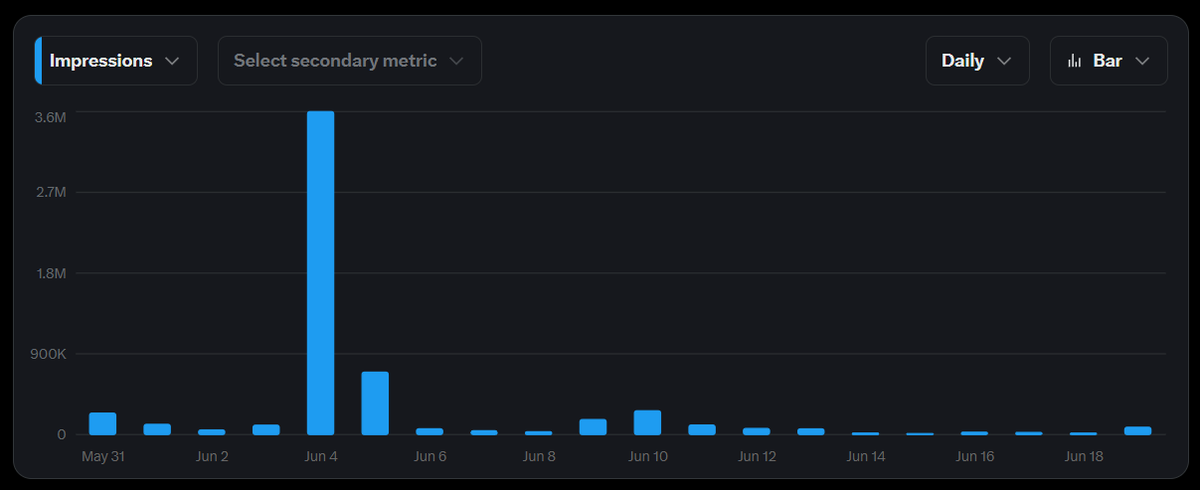
X Analytics Data, June 2026
The week before I had my biggest weak ever on X. I reached 5 million impressions. And then suddenly, I couldn’t get a single tweet to be seen.
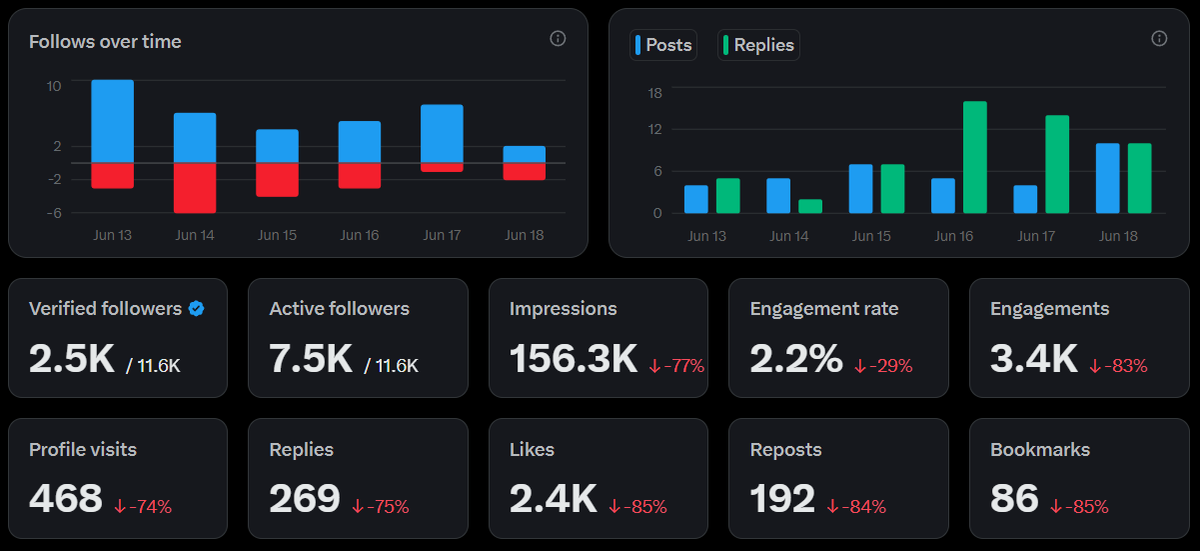
X Analytics this Week
Thankfully, I knew the reason. It was long reported that a consistent amount of unfollows, blocks or mutes can damage your For Your Promotion (Out of Network, OOO) reach.
This is what causes your tweets to be seen by the broader X community.
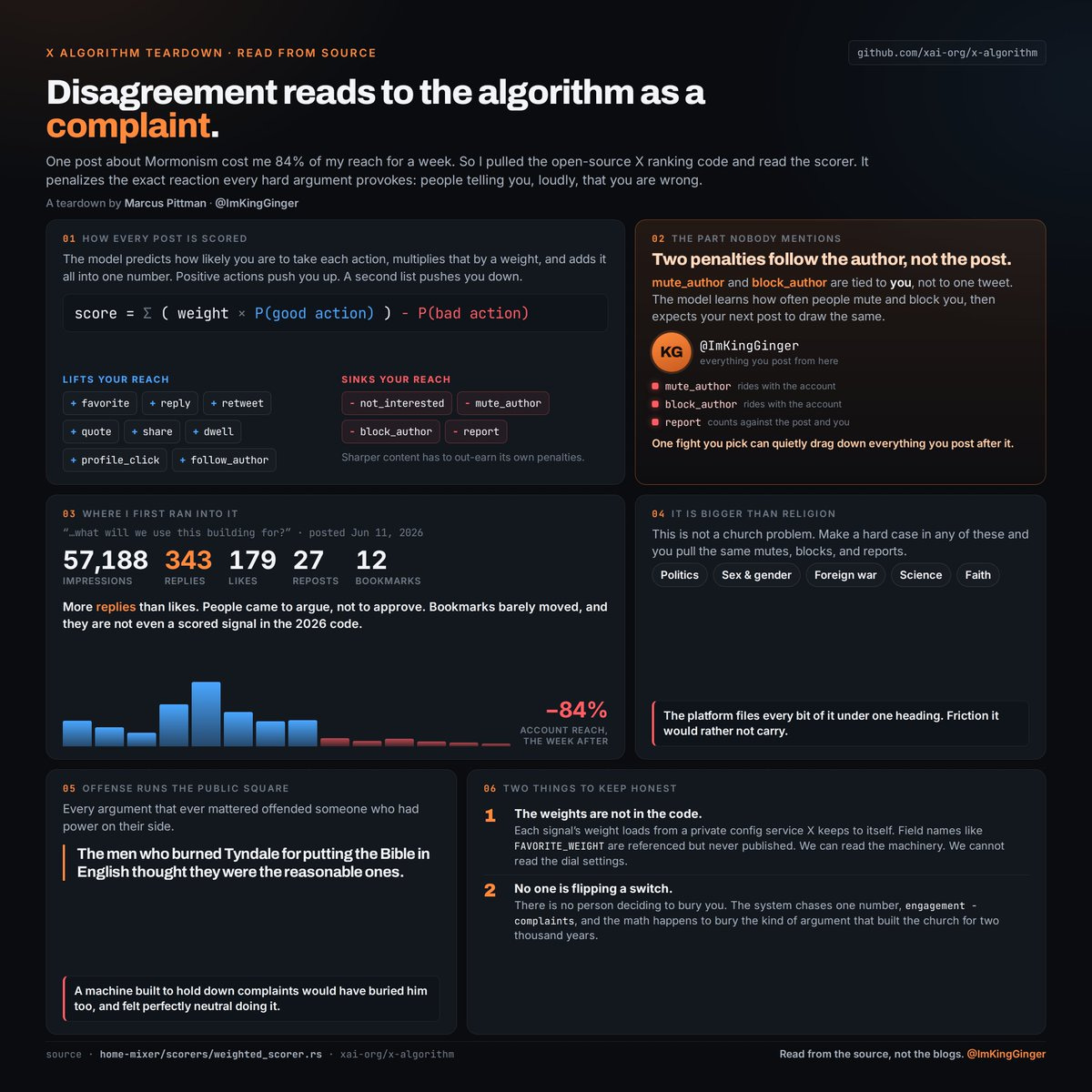
Infographic summary of analytics, source code and relevant tweet.
It works like this. The model predicts how likely you are to like, reply, repost, quote, or share a post, and those add to your score. Then it subtracts a second list. Mutes pull you down. Blocks pull you down. Reports pull you down. And two of those, the mute and the block, are aimed at the person, not the post.
The model watches how often people block and mute you over time. It starts expecting your next post to earn the same. One fight you pick weighs down everything you say after it.
So what I did is I ran the X Source code through AI, alongside of my tweet history, and it pinpointed that specific Mormon post for me. I turned that into an infographic that explains how a single tweet poorly receives returns all your work to zero.
Here is what it said:
Here’s why that becomes an account problem and not just a post problem, straight from the scorer. The weighted score adds positive terms for favorite, retweet, quote, share, and bookmark-adjacent shares, and it subtracts
not_interested_score, mute_author_score, block_author_score, and report_score. Notice those last three are attached to the author, not the post. The model learns them from how often people block, mute, and report you, then applies that as a predicted penalty to everything you post next. So a single post that draws a wave of blocks and reports doesn’t just sink that post. It raises the model’s predicted probability that your future posts will get the same treatment, and that drags down your whole candidate pool. That’s the account-level suppression you’re feeling.
The other half is the Grox path. That service runs post-category classification and PTOS policy enforcement, and a post drawing a report spike on religious-targeting grounds is the kind of thing that gets pulled into a sensitive or borderline category, after which VFFilter trims it out of out-of-network candidate sets. Combine the two and you get exactly the pattern your first screenshots showed: out-of-network reach floored while your core followers still see and engage you.
*Obviously this is an AI generated summary. Would love for people more knowledgeable than me to deep dive and verify. But I think a decent case can be made from it.
Ever since that tweet was made and the consequences of it, I noticed that I’ve been trained to make sure my tweets are inoffensive and won’t upset people. I second guess whether a post will be seen as controversial or whether asking for debate and discussion would be flagged for “Engagement Bait.”
This creates a massive problem for an app claiming to be the Public Square. A public square should be filled with heated discussion and lively debate. Properly done some people are going to be mad. There are people that want their X timeline to just be cute kitten videos or AI generated anime girls, but I would assume a vast majority do want to engage, discuss and fight passionately about the topics they care for.
This is sort of the centerpiece of theology and apologetics. Fighting for what is true. These arguments by nature are passionate, and heated. And the current X algorithm actually discourages people from these sorts of lively debates or controversial topics.
But it doesn’t stop at theology.
It absolutely applies to debating politics, which has been the center of the X experience. Just because a bunch of democrats hate your conservative interpretation of the world and don’t ever want to see your posts again doesn’t mean that what you posted was not valuable to a vast majority. The same could be said for debating the role of AI, many of which are very passionate one way or the other. These debates even unintentionally can cause mobs to turn on people.
One tweet I had this month that resonated with the entertainment space caused me to get a massive influx of new followers, all with they/them profiles. The next week, they unfollowed me once they learned my political stances. I was the one punished, but I didn’t do anything different or abnormal.
The point is that the X algorithm shouldn’t be able to be reset based on a single tweet that the mob rejected. Mob’s should not be able to attack an account by linking it on a rabid Reddit page or Discord. But as it stands now, that’s quite easy to do.
People with weak stomachs block and mute. So they have all the power with this current model. So in essence the current algorithm is not on the path of being a passionate public square, but a timeline filled with harmless kitten videos.
So my hope of posting this is not because I have a bone to pick with the X developers, or that I even hate X. I say all of this to bring attention to how easily exploitable the algorithm is by angry masses, or just by normal everyday disagreement and timeline filtering.
I actually really love this platform. The creator payout has been a huge blessing to me (and actually my primary source of income). I want to put in hard work on this app and grow on this platform, but I don’t want to have to perpetually roll a bolder up a mountain for it to go all the way back down to sea-level because I upset a group of people. I want to engage people in rigorous debate. I want to be able to share ideas that invoke all sorts of emotions. Including outrage. As we have learned over the past ten years of social media censorship
PS I am not accusing X of censorship, just that current consequences of the way the algorithm tries to limit human behavior creates self-censorship naturally because the consequences are so great.
PPS: If X would like to work with some guys who have a firm understanding of technology and social media but also are well attuned with theological discourse and understanding I would be happy to volunteer to assist the X devs in learning about theological discourse in the public square. I think it would greatly improve the algorithm, and also allow for proper religious and theology filters (down to the proper denominations and divisions) on the timeline. I have some pretty significant behind the scenes experience working on this very problem for marketing and advertising we can talk about one on one.
"The model learns them from how often people block, mute, and report you, then applies that as a predicted penalty to everything you post next." -- this makes social media utterly worthless and the next platform that doesn't penalize someone for using the features available to keep a user's experience pleasant will win the game.