


Over the past four years of building LOOR.tv, I have learned a lot about the Christian and Faith Based film industry that most people don’t ever speak about in public. You can’t blame them, the community is so interconnected and being blacklisted is really easy for them.
But the reason I got into LOOR.tv wasn’t to become part of the cool kids club in Franklin, TN. I got into the industry to change it. To make Christian films better, to move the industry forward, and to bless filmmakers and talent with a way to make content they can be proud of.
We started LOOR by wearing a simple t-shirt at Christian film conferences that simply said, “Christian Movies Shouldn’t Suck.” The truth is, we didn’t know any better and, like most companies that start out not knowing what they shouldn’t do, it works to their advantage. Plus, we really didn’t have anything to lose.
Filmmakers were immediately drawn to our shirts. We’d get into conversations with the most amazing and talented filmmakers. Many who worked high up in Hollywood with years of experience, some who were scrappy homeschool kids looking to make a name for themselves who knew as little about what they were getting into as we did.
They loved the shirt. They asked about what we were doing here. We told them we’re building a streaming platform that will change things so they don’t have to make cheesy Hallmark rip-offs anymore.
At the faith based film conferences, we would set up in the evening and host whiskey and cigars for all the filmmakers, completely off the schedule of course. We had tons of talent show up. Some nights, Jason Farley and myself would be up till 3am or later just listening to filmmakers and asking them how we at LOOR could solve the problems of the industry.
For some of them, it was the first time “Industry Executives” as they called us ever just hung out with them and got to know them. Most of the interactions with distributors and filmmakers were in five minute “Pitch-a-Thons” that they had the artists had to pay extra money for, and in most instances felt more like a cos-play than a legitimate chance. Speaking of cos-play, there was on film festival where the filmmakers could pay extra money to dress up and pretend to be on a red-carpet experience. Most of the conferences, but not all of them, felt more like grift than an actual opportunity.
So our first lesson as we began to build our relationships with the artists was realizing that the Christian film industry was swamped with incredible talent. There was an overwhelming abundance of it. Much more great projects and capabilities to create those projects than we ever thought. More talent than our little startup who didn’t even have a website could ever take on.
So that left a question, a question that any Christian filmmaker could quickly answer. “Why are Christian movies in a perpetual state of mediocrity, when all of this talent is widely available?”
What we learned is that there were only two options.
1. The Christian film industry was incredibly incompetent.
2. The Christian film industry was creating this content intentionally.
Think about it for a moment. Let’s leave Left Behind, behind and say the modern Christian film industry started after Passion of the Christ, 20 years ago. Mel Gibson’s Passion was a tremendous success and one of the top grossing movies in decades.
The most obvious play would have been to duplicate that movie hundreds of times like it was the Marvel Cinematic Universe. But that never happened. In fact, nothing happened really for about 10 years. Then we got the first God’s Not Dead.
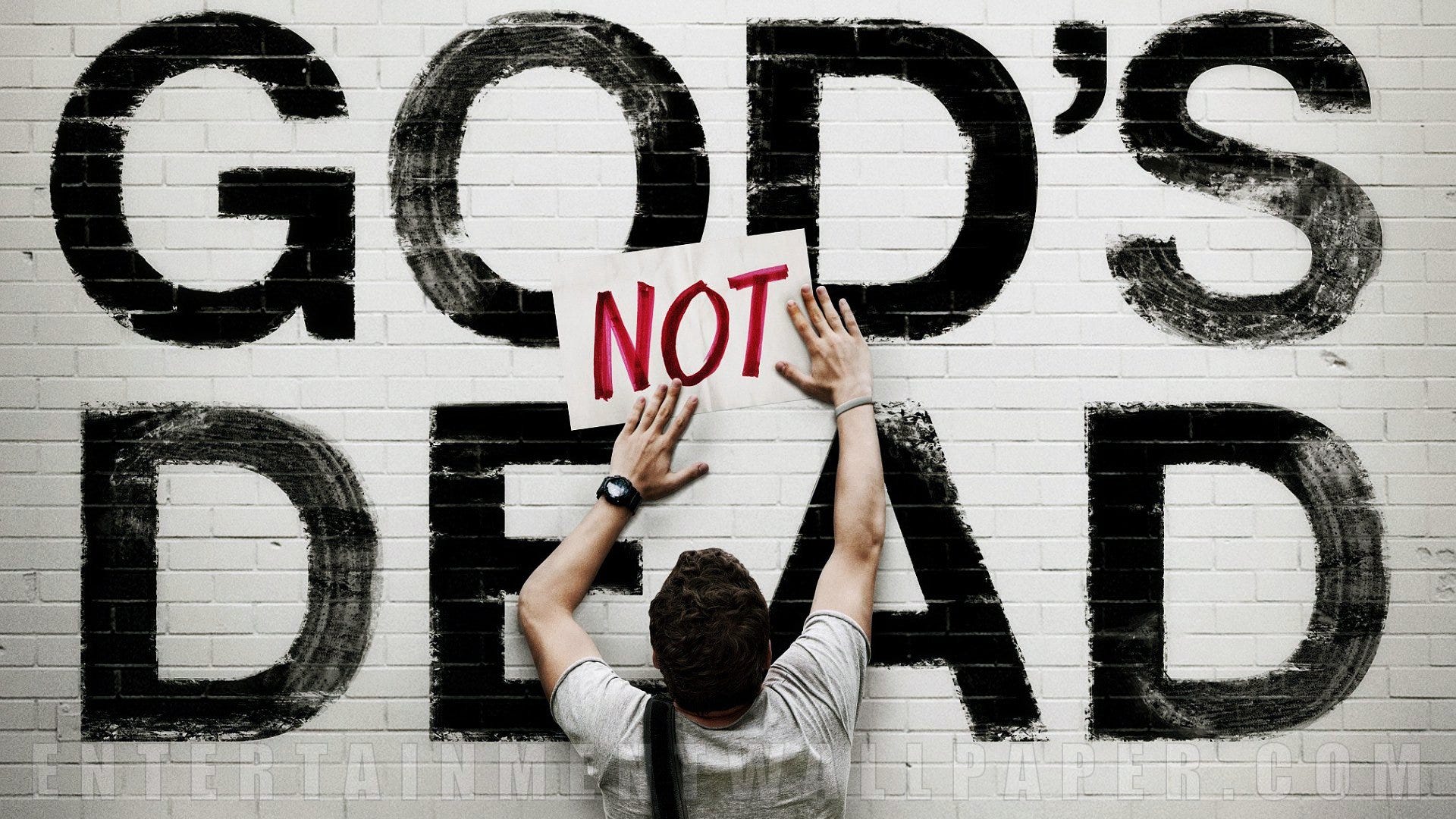
God’s Not Dead was subpar. It was an indie film and it was pretty much non-offensive but upset the growing “New Atheism” crowd just enough to make some waves in the box office. The movie was advertised to pastors as an evangelistic tool, with a strategic plan to get the Church to pay for all the tickets in the theater and pass them out for free. We know the man who by his own admission regretably conceived this idea, and he told us that as successful as it was, it single-handedly created the Dragon that LOOR is trying to slay.
He realized that when you are making movies for pastors, and not the public, the movies have to be inoffensive enough that a pastor can recommend the movie from the pulpit, regardless of denominational differences. This allowed movies to sell tons of tickets no matter the quality of the film and irrespective of anything Hollywood was putting out the same weekend.
But that was not all. Christian movies didn’t spend a lot of time in the box office, so they had to rely on retail sales to increase the long tail profits of the film. Since Christian Bookstores had nationwide coverage, the movies also had to resonate with the Bookstore chains target consumer. The 35yo Housewife. They called this avatar Becky.
So now, every Christian movie had two audiences. A pastor who didn’t want to offend their congregation and Becky who wanted a sort of rom-com movie they could bring home to watch with the family.
But there was another audience as well. That was the major Hollywood Studios and their distribution monopoly.
If a movie could not get a distribution deal with Sony or Lionsgate, or some other non-Christian distribution company, the movie could not get into the theaters, and there would be no P&A, a term for marketing dollars. Print and Advertising.
So not only did the Christian movies have to be inoffensive enough to attract pastors across denominational divides, and then be feminine enough to attract the female Christian bookstore shoppers, it also had to be inoffensive enough to get the approval of major distribution deals from secular studios. And if you recall the events post Passion of the Christ, they didn’t say “Hey, that movie made a lot of money so we should make more of that.”
Instead, Hollywood blacklisted almost everyone that worked on the film.
Newmarket Films, which distributed Passion, was then acquired by Lionsgate, who is still the main distributor of modern Christian movies today.
And thus the Christian Film industry was born. Christian films became a specific genre, created in an executive room by marketers, Hollywood and retailers.
It wasn’t incompetence. It was intentional. It was strategic.
As people began complaining about the quality of Christian films, a lot of people had theories about why they were so bad. And this is what greatly discouraged me and motivated myself and the team at LOOR to buckle down and to go even harder.
What came about was several excuses as to why Christian movies were so terrible and have become a meme. So instead of admitting that people were growing tired of the stale, sterile content, and trying to change the genre and move things forward, they blamed the filmmakers and directors. They even blamed the audience.
The argument was a circle that went like this.
People hate Christianity > So it doesn’t appeal to a large market > So Christian movies don’t make a lot of money > So we can’t afford great talent > So the movies are not that good and the acting and writing is bad > So they don’t make money.
So that is the perpetual cycle we have been told as to why Christian movies are the way they are. We have to hire second rate actors and directors because Christianity is on the decline and Christianity is persecuted, so they don’t do well in the box office.
The infuriating thing about this and as we built LOOR, we realized that none of this is true. Christian movies were made in a lab and are created to be inoffensive and shallow very purposefully.
We’ve spoken to hundreds of talented filmmakers. How do we know they are talented, you might ask? Well because they work in very high levels for Hollywood and have done so for years. They’ve pitched us the most amazing ideas. We ask why didn’t anyone pick this up? The artists would tell us, “because it’s outside the genre.”
Adult animation, science fiction, action and adventure, horror. Amazing stories that need to be told that are shut down as fast as you can say the title. Not because of a lack of talent, but because of a lack of Hallmark style content that appeals to Bookstore Becky and her Pastor. It’s on purpose. It’s intentional.
I can recall pitches we received that should have been purchased immediately. I remember Jason and I trying to help some of the artists, before we knew better, and standing up in the middle of several Pitch-a-Thons and giving a standing ovation to artists for their pitch, letting every distributor in the room know this was a good one.
None of it mattered, though. Because the Christian film industry doesn’t care about good stories or the talent that is capable of producing them. They only swipe right on a specific type, and swipe left on everything else.
This is why LOOR is so important. It’s because that we understand, better than anyone else, that in order to change the industry you have to let these artists do what God made them to do. Just tell good stories and give them the freedom to do that.
At LOOR we built a streaming platform that completely bypasses the gatekeepers in the Christian film industry and Hollywood. The filmmakers can pitch their projects directly to the audience, receive funding from the audience and premiere their project on the same platform, for the same audience that funded them. It’s pure underground, indie incubation.
Some of their projects might offend people. Some projects might wind up flops. But decentralizing the funding and greenlighting process is the only way you are going to change the industry for the better.
Let me ask you if you have not done so, to share this article and encourage your friends to subscribe to LOOR. The model is pretty simple. The more subscribers we have, the bigger projects artists can make. Every subscriber spends their monthly subscription funding content pitched to them directly by the audience. The more subscribers spending their subscription the faster projects fund, get made and the entire industry is disrupted. If there is a project you really are excited about you can contribute as much to them as you like.
But most importantly, once a project is funded and has premiered, everyone receives the inheritance and can watch it. Whether you funded it or not.
So if you believe that “Christian Movies Shouldn’t Suck” how about giving artists a chance to really push the boundaries, maybe even offend you, or at the very least prove that they actually are talented despite what the contrived rumors of Hollywood executives would have you believe. Hollywood believes that they have the power to determine the stories for Christians, I think we should prove them wrong.
One factor you don’t discuss but would have seemed important is the fact that evangelicalism is very uncomfortable with any story whose characters don’t A) remain within moral bounds and B) find a neat redemption in the end. There’s a reason Silence, The Mission, Calvary, and even the Exorcist were all originally written by Catholics. Meanwhile, Left Behind is much older than God’s Not Dead but exhibits many of the same tendencies as God’s Not Dead
What about encouraging more Christians to make/be involved in mainstream films? I think of the crossover Christian rock bands, and those who have Christian members, but don’t label the band Christian.
These days, a lot of people outside the faith are resonating to the Christian story in different ways, so I feel like there’s an opening there!